HOME
POLITICS
CLIMATE
BUSINESS
SCIENCE
WORLD
HISTORY
LIFESTYLE
EDITORIAL
RESOURCES
CONTACT

Showing posts with label Environment. Show all posts


The Plight of the Bumblebee


With all the focus on the disappearance of the honeybee, there has been little discussion about the plight of the bumblebee, one of the hardest workers in the wild world of agriculture, despite this warning issued by the National Academy of Sciences October 2006.

That focus may now change as word comes from scientists that at least one bumblebee species from the Northwestern region of the United States, Franklin's Bumblebee,
may have gone extinct.
This is a serious development. Not only because the loss of any species due to human activity is, in this writer's opinion, unconscionable, but because we depend on this species more than we've taken the time to understand.
According to this newly released National Academy of Sciences report, the bumblebee is one of many pollinators losing their battle to survive because of 'habitat lost to housing developments and intensive agriculture, pesticides, pollution and diseases spilling out of greenhouses using commercial bumblebee hives.'
Long-term trends for several wild bee species -- especially bumblebees -- as well as some butterflies, bats, and hummingbirds also show population drops, the committee found. -snip-

Like the honeybee, the bumblebee has been hurt by the introduction of a non-native parasite. Many pollinator declines are associated with habitat loss...
It turns out that our native American bumblebee (the honeybee was imported) does more than provide a pleasant bass note to the summer hum we hear outside our window...

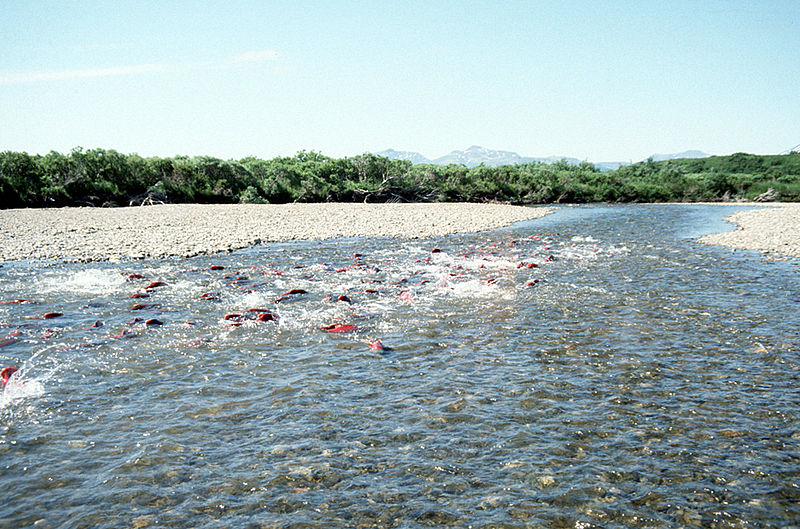


Chinook Salmon at 'disastrous' all-time low - season may have to be halted


The Pacific Fishery Management Council has warned that entire the West Coast salmon season may have to be halted due to the lack of available fall Pacific chinook salmon.

“This is very bad news for West Coast salmon fisheries,” said Pacific Council Chairman Don Hansen. “The word ‘disaster’ comes immediately to mind, and I mean a disaster much worse than the Klamath fishery disaster of 2006.”
Sacramento River salmon are primarily caught off California and Oregon, but are also found off Washington and as far north as British Columbia. They are typically one of the healthiest and most abundant stocks on the west coast, and are the dominant contributor to both commercial and recreational fisheries off California and most of Oregon. ~snip~

The forecast of very low abundance is based on the return of “jack” salmon in the fall of 2007. Jack salmon are young male fish that return to the rivers as two year olds, unlike adult fish which return at age three or older. Jack salmon are currently the best statistical indicator of returning adult population the following year. Only about 2,000 Sacramento River fall Chinook jacks returned in 2007, by far a new record low count. This compares to a long‐term average of about 40,000 and the previous record low of about 10,000, which occurred in 2006.
“The biological situation for Sacramento River fall Chinook salmon is unprecedented in our experience,” said Pacific Council Executive Director Dr. Donald McIsaac. “We are looking at back-to-back record low brood year production, even though the parent spawning levels exceeded the spawning goal.”

The reason for the collapse is, as yet, undetermined, but both hatchery and wild fish are affected. Forty-six possible causes are under review. These potential causative factors include: Ocean conditions, freshwater conditions, abnormal interactions with prey (krill) or predators (sea lions), "as well as human-caused effects such as pollution, water diversions, construction, habitat loss, or changes in hatchery operations.


“We need to thoroughly research what has gone wrong for these two broods of Sacramento fall Chinook,” said Marija Vojkovich, the California Department of Fish and Game representative for the Pacific Council. “But the first step is to identify where to focus the research.”

“Regarding fishing seasons affecting Sacramento fall run Chinook, I won’t be surprised to see the Council look at the ‘totally closed’ option as one option, that is, closed to both sport and commercial fisheries,” said Council Vice-Chairman Dave Ortmann. “This is a very important and valuable stock of fish, particularly to the regional salmon fisheries off California and Oregon.”
Public hearings to receive input on the options are scheduled for March 31 in Westport, Washington and Coos Bay, Oregon, and for April 1 in Eureka, California.

At its April 7 ‐12 meeting in Seattle, Washington, the Council will consult with its scientific and fishery stakeholder advisory bodies, hear public comment, and choose a final option for ocean commercial and recreational salmon fishing.
The federal agency added that, even if they don't close the season, there are likely not enough salmon available to the fisheries to allow for a viable season.

Pacific Fishery Management Council Report here.

The National Park Service's Cascades Salmon Conservation Page here.


USDA recalls 143 million pounds of beef

Cross-posted on Reuters, Chicago Sun-Times

The USDA has recalled 143 million pounds of beef produced from a Chino, CA slaughterhouse, making this the largest beef recall in the U.S.


LOS ANGELES - The U.S. Department of Agriculture on Sunday recalled 143 million pounds of frozen beef from a Southern California slaughterhouse that is being investigated for mistreating cattle.

The federal agency said the recall will affect beef products dating [from] Feb. 1, 2006, that came from Chino, California-based Westland/Hallmark Meat Co., which supplies meat to the federal school lunch program and to some major fast-food chains.

Secretary of Agriculture Ed Schafer said his department has evidence that Westland did not routinely contact its veterinarian when cattle became non-ambulatory after passing inspection, violating health regulations.
The government shut Westland down on Friday after video revealed they were using forklifts to push sick cattle to slaughter. Two former employees are being charged with animal cruelty. The investigation will determine if further charges will be brought.
Jack in the Box, a San Diego-based company with restaurants in 18 states, told its meat suppliers not to use Hallmark until further notice, but it was unclear whether it had used any Hallmark meat. In-N-Out, an Irvine-based chain, also halted use of the Westland/Hallmark beef. Other chains such as McDonald's and Burger King said they do not buy beef from Westland. Link.
"We don't know how much product is out there right now. We don't think there is a health hazard, but we do have to take this action," said Dr. Dick Raymond, USDA Undersecretary for Food Safety.

Read more


Tokyo Declaration: Twelve Well Known Brands Vow to Fight Global Warming


In a "Tokyo Declaration" announced today, Sony, Nokia and ten other well known brands have announced that
they will work with the World Wildlife Fund to involve their suppliers, customers and transportation partners in the fight to halt global warming:
Tokyo – A business group including leading companies such as Sony, Nokia and Nike has come together to present the Tokyo Declaration, a joint call to tackle the urgent issue of climate change. Signing the declaration at the Climate Savers Summit 2008 held by WWF and Sony in Tokyo today, a dozen business leaders highlighted that the world’s greenhouse gas emissions must be reduced by more than 50 percent by 2050, and that emissions must peak and start to decline within the next 10 to 15 years in order to keep global warming below the dangerous threshold of 2 degrees Celsius.

The text of the declaration (PDF) lists twelve signatory brands: Allianz, Catalyst, Collins, Hewlett Packard, Nike, Nokia, Novo Nordisk, Sagawa, Sony, Spitsbergen Travel, Tetra-Pak and Xanterra. The announcement was made by Sony Chairman and CEO Sir Howard Stringer just before the anniversary of the Kyoto Protocol and is designed to bring attention in the business community to the urgent nature of climate change.

More information is available through the World Wildlife Fund and through this Reuters report.


EPA sued over Greenhouse Gas Emissions


Cross-posted on Reuters

Just after the Bush Administration signed an auto fuel efficiency bill, they denied a request for a waiver by California to tighten their own emission standards.

The Bush administration said Wednesday night that it would deny California's bid to set stricter vehicle emissions standards than federal law required as part of the state's efforts to fight climate change.

The E.P.A's decision was a victory for the American auto companies, and came just hours after President Bush signed legislation that will raise fuel economy standards by 40 percent to 35 miles a gallon in 2020.

Had the E.P.A. agreed to the waiver, California and other states would have enacted rules requiring the auto companies to achieve a 30 percent reduction of emissions by cars, trucks and sport utility vehicles by 2016. The rules were set to begin taking effect with 2009 model year vehicles, some of which go on sale as soon as next month. Link.

California's effort to adopt the new emission standards was halted by the E.P.A.'s refusal to grant a waiver for the last two years. Twelve states, California, Connecticut, Maine, Maryland, Massachusetts, New Jersey, New Mexico, New York, Oregon, Pennsylvania, Rhode Island, Vermont and Washington, then sued the E.P.A. to demand they make a decision on the waiver.

That is the decision that came down tonight -- just after Bush signed an auto fuel economy bill that he praised as a step toward energy independence....

"This decision is like pulling over the fire trucks on their way to the blaze," said Fred Krupp, president of Environmental Defense. Krupp has sent out a general e-mail asking everyone to send an email to EPA administrator Stephen Johnson to condemn the decision.

With the twelve states involved and the
governors of Arizona, Colorado, Florida and Utah saying they intend to follow California's standards, as well, the next step would be for the states to sue the E.P.A. Given the prior court decisions over the past two years in the effort to get the E.P.A. to make a decision on a waiver, which resulted in rulings in the states' favor, it is likely the E.P.A.'s position will not hold up. However, the amount of time involved for such a court process will likely have the same result the E.P.A. is trying for: to delay the implementation of standards as long as possible in support of auto makers.

Environmental Defense has responded with the seeming quandary this has put them in. They support the passage and signing of the new auto fuel standards bill, but do not want to see that used as an excuse to limit the 12-17 states ability to enforce more strict standards, based on their individual needs:

EPA denies California's request: In a decision that ignores both science and the law, the EPA has rejected California's request to allow its ground-breaking law to go forward. Link.

That's the Bush Administration's version of the E(vironmental) P(rotection) Agency.

A great deal of protection for industry.


The environment? Not so much.


The Bali Communiqué: Big business weighs in on Climate Change


Q. When is it time to take climate change seriously?

A. When even Fox News' parent corporation says so.

That's right. NewsCorp has weighed in (at least on paper) as part of the Prince of Wales's Group on Climate Change at the University of Cambridge's announcement that 150 signatory companies (including NewsCorp) -- comprising many of the world's most influential corporations and accounting for trillions of dollars in trade and some of the best known global brands -- have circulated a petition in advance of the upcoming U.N. Bali Climate Conference "calling for a comprehensive, legally binding United Nations framework to tackle climate change."

The Bali Communiqué's specific requests:
- A comprehensive, legally binding United Nations framework to tackle climate change.

- Emission reduction targets to be guided primarily by science.

- Those countries that have already industrialised to make the greatest effort.

- World leaders to seize the window of opportunity and agree a work plan of negotiations to ensure an agreement can come into force post 2012 (when the existing Kyoto Protocol expires).
Citing the U.N.'s alarming report on climate change, issued last week, the signatories are also requesting a minimum 50% reduction in emissions by 2050:

The hastily prepared petition drive, coordinated through the environmental office of Britain's Prince Charles, is signed by leaders from mainstream powerhouse companies such as Shell UK, GE International, Coca-Cola Co., Dupont Co., United Technologies Corp., Rolls Royce, Nestle SA, Unilever, British Airways and Volkswagen AG. Link.

The list also includes the aforementioned NewsCorp, AIG, ABAmro, Sun Microsystems, Nike, Nokia, and many other firms, all of whom now cite climate change as a risk to commerce as well as to the planet.

Here's the link to the
signatories list.

Let's hope their efforts make a difference at the upcoming conference.