HOME
POLITICS
CLIMATE
BUSINESS
SCIENCE
WORLD
HISTORY
LIFESTYLE
EDITORIAL
RESOURCES
CONTACT

Showing posts with label Endangered Species. Show all posts


The Plight of the Bumblebee


With all the focus on the disappearance of the honeybee, there has been little discussion about the plight of the bumblebee, one of the hardest workers in the wild world of agriculture, despite this warning issued by the National Academy of Sciences October 2006.

That focus may now change as word comes from scientists that at least one bumblebee species from the Northwestern region of the United States, Franklin's Bumblebee,
may have gone extinct.
This is a serious development. Not only because the loss of any species due to human activity is, in this writer's opinion, unconscionable, but because we depend on this species more than we've taken the time to understand.
According to this newly released National Academy of Sciences report, the bumblebee is one of many pollinators losing their battle to survive because of 'habitat lost to housing developments and intensive agriculture, pesticides, pollution and diseases spilling out of greenhouses using commercial bumblebee hives.'
Long-term trends for several wild bee species -- especially bumblebees -- as well as some butterflies, bats, and hummingbirds also show population drops, the committee found. -snip-

Like the honeybee, the bumblebee has been hurt by the introduction of a non-native parasite. Many pollinator declines are associated with habitat loss...
It turns out that our native American bumblebee (the honeybee was imported) does more than provide a pleasant bass note to the summer hum we hear outside our window...

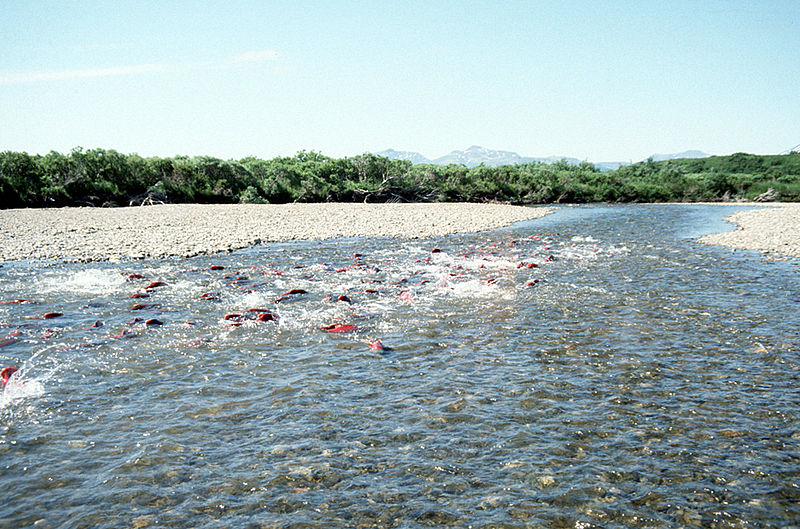


Chinook Salmon at 'disastrous' all-time low - season may have to be halted


The Pacific Fishery Management Council has warned that entire the West Coast salmon season may have to be halted due to the lack of available fall Pacific chinook salmon.

“This is very bad news for West Coast salmon fisheries,” said Pacific Council Chairman Don Hansen. “The word ‘disaster’ comes immediately to mind, and I mean a disaster much worse than the Klamath fishery disaster of 2006.”
Sacramento River salmon are primarily caught off California and Oregon, but are also found off Washington and as far north as British Columbia. They are typically one of the healthiest and most abundant stocks on the west coast, and are the dominant contributor to both commercial and recreational fisheries off California and most of Oregon. ~snip~

The forecast of very low abundance is based on the return of “jack” salmon in the fall of 2007. Jack salmon are young male fish that return to the rivers as two year olds, unlike adult fish which return at age three or older. Jack salmon are currently the best statistical indicator of returning adult population the following year. Only about 2,000 Sacramento River fall Chinook jacks returned in 2007, by far a new record low count. This compares to a long‐term average of about 40,000 and the previous record low of about 10,000, which occurred in 2006.
“The biological situation for Sacramento River fall Chinook salmon is unprecedented in our experience,” said Pacific Council Executive Director Dr. Donald McIsaac. “We are looking at back-to-back record low brood year production, even though the parent spawning levels exceeded the spawning goal.”

The reason for the collapse is, as yet, undetermined, but both hatchery and wild fish are affected. Forty-six possible causes are under review. These potential causative factors include: Ocean conditions, freshwater conditions, abnormal interactions with prey (krill) or predators (sea lions), "as well as human-caused effects such as pollution, water diversions, construction, habitat loss, or changes in hatchery operations.


“We need to thoroughly research what has gone wrong for these two broods of Sacramento fall Chinook,” said Marija Vojkovich, the California Department of Fish and Game representative for the Pacific Council. “But the first step is to identify where to focus the research.”

“Regarding fishing seasons affecting Sacramento fall run Chinook, I won’t be surprised to see the Council look at the ‘totally closed’ option as one option, that is, closed to both sport and commercial fisheries,” said Council Vice-Chairman Dave Ortmann. “This is a very important and valuable stock of fish, particularly to the regional salmon fisheries off California and Oregon.”
Public hearings to receive input on the options are scheduled for March 31 in Westport, Washington and Coos Bay, Oregon, and for April 1 in Eureka, California.

At its April 7 ‐12 meeting in Seattle, Washington, the Council will consult with its scientific and fishery stakeholder advisory bodies, hear public comment, and choose a final option for ocean commercial and recreational salmon fishing.
The federal agency added that, even if they don't close the season, there are likely not enough salmon available to the fisheries to allow for a viable season.

Pacific Fishery Management Council Report here.

The National Park Service's Cascades Salmon Conservation Page here.